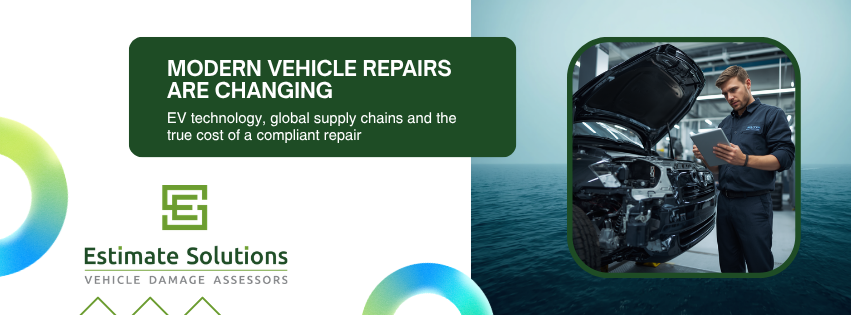
Why Rising EV Repair Costs, Global Supply Chains and Modern Vehicle Technology Are Changing the Insurance Repair Industry


The UK accident repair industry has never stood still, but the pace of change over the past few years has been unprecedented. Electric vehicles are becoming more common on our roads, vehicle technology is advancing faster than ever, insurers are under increasing financial pressure, and global events continue to influence the availability and cost of replacement parts.


A recent BBC News article highlighted one of the most visible consequences of this change – the increasing cost of insuring electric vehicles. While many motorists naturally focus on higher insurance premiums, those working within the insurance repair sector know the story goes much deeper. Behind every premium is a claim, behind every claim is a repair, and behind every successful repair is an accurate, compliant and professionally prepared estimate.


For independent repairers, these changes present both challenges and opportunities. At Estimate Solutions, we believe that understanding the wider picture enables businesses to prepare for the future rather than simply reacting to it. As the insurance repair landscape evolves, professional estimating has become more valuable than ever.


Electric vehicles are changing the repair process


Electric vehicles are no longer a niche product. Every month, more battery electric and hybrid vehicles arrive in bodyshops across the UK. While many cosmetic repairs may appear similar to those on petrol or diesel vehicles, the technology beneath the panels is significantly more complex.


Modern EVs contain sophisticated battery management systems, high-voltage wiring, advanced driver assistance systems (ADAS), radar sensors, cameras and electronic safety equipment. Components that may have once been repaired can now require replacement, recalibration or manufacturer-approved diagnostic procedures before a vehicle can safely return to the road.


The BBC recently reported that even relatively low-speed impacts can result in unexpectedly expensive repairs because of the location of sensitive electrical components and the specialist processes required to complete repairs safely. This helps explain why electric vehicles often attract higher insurance premiums than equivalent petrol or diesel models.


For repairers, this means that estimating has become far more than simply pricing parts and labour. Every operation must be justified, every repair method must comply with manufacturer guidance, and every estimate must reflect the latest approved procedures.


Repair complexity continues to increase


Today's vehicles are effectively computers on wheels.

Many now include:

  • Multiple cameras
  • Radar sensors
  • Parking systems
  • Lane keeping technology
  • Adaptive cruise control
  • Autonomous emergency braking
  • High-voltage battery systems
  • Connected vehicle technology

These innovations undoubtedly improve road safety, but they also introduce greater complexity into the repair process. Even what appears to be a straightforward bumper replacement can involve removing sensors, recalibrating cameras, carrying out diagnostic scans and following strict manufacturer repair methods. Missing just one of these operations could compromise vehicle safety or result in delays during the insurer approval process. For insurers, this creates rising claim costs. For repairers, it creates additional administration and greater scrutiny of repair estimates.


Why insurers are scrutinising estimates more than ever


The insurance sector continues to face significant financial pressure. Claims inflation, increasing labour costs, higher vehicle technology costs and longer repair times have all contributed to rising average claim values. Courtesy vehicle costs also increase when repairs take longer due to specialist parts or technician availability. As a result, insurers naturally require greater evidence that every repair operation included within an estimate is necessary and compliant. This should not be viewed as insurers simply looking to reduce costs. It is about ensuring repairs are completed correctly, safely and in accordance with manufacturer guidance while maintaining fairness for all parties involved. Professional estimating therefore becomes the bridge between repairers and insurers, ensuring both sides are working from the same factual, evidence-based information.


Global supply chains remain under pressure


Whilst electric vehicles have dominated recent headlines, another issue continues to influence the repair industry behind the scenes: global supply chains. Recent geopolitical tensions, including concerns surrounding the Strait of Hormuz, have highlighted just how interconnected modern manufacturing has become. Although many vehicle parts do not physically pass through the Strait of Hormuz, the region remains one of the world's most strategically important shipping routes because a significant proportion of global oil and energy supplies transit through it. Any disruption has the potential to increase fuel costs, shipping costs and manufacturing expenses across multiple industries.


The accident repair sector is not immune to these pressures. Higher transport costs can increase the price of replacement parts. Longer shipping times may extend repair lead times. Manufacturers may experience delays obtaining raw materials or electronic components. These factors can ultimately affect repair

schedules, courtesy vehicle durations and overall claim costs.


It is important not to overstate the impact. At the time of writing, there is no evidence of widespread UK parts shortages directly attributable to events in the Strait of Hormuz. However, recent years have demonstrated how quickly international events can influence domestic supply chains.


The lessons learned during the pandemic remain relevant today. Resilient businesses are those that prepare for uncertainty rather than assume stability.


The role of industry organisations


Industry organisations continue to play an important role in helping the repair sector adapt to these changes.


The National Body Repair Association (NBRA) has consistently highlighted the need for sustainable repair rates, investment in skills and recognition of the increasing complexity involved in repairing modern vehicles. The association continues to work with repairers, insurers and manufacturers to improve standards across the sector.


Similarly, ABP (Automotive Body Professionals Club) provides a valuable platform for sharing industry news, technical developments and best practice. Through conferences, technical publications and industry events, ABP encourages collaboration between insurers, repairers, manufacturers and suppliers.

Both organisations recognise that today's repair environment requires greater technical knowledge, improved training and closer cooperation throughout the repair journey.


These are objectives that align closely with the work undertaken by Estimate Solutions every day.


Why independent repairers need strong estimating support


Independent repairers often face a unique challenge. Unlike larger repair groups, many smaller businesses do not have dedicated estimating departments or the resources to continually monitor every change to repair methods, manufacturer guidance and estimating systems.


Yet they are expected to produce estimates that satisfy insurers, comply with current repair methods and accurately reflect every operation required to complete repairs safely.


That is precisely where Estimate Solutions provides value.


Our experienced team produces professional Audatex estimates that reflect current repair procedures, manufacturer guidance and industry best practice. We help independent repairers present clear, compliant and evidence-based estimates that support productive conversations with insurers. Our role is not simply to prepare estimates. We help repairers protect profitability while ensuring insurers receive accurate information upon which informed decisions can be made.


It is a partnership built on experience, professionalism and trust.


Protecting profitability in a changing industry


Many repairers focus understandably on labour rates or parts margins when discussing profitability.


However, profitability often begins much earlier.

  • It starts with ensuring every legitimate repair operation has been identified.
  • It means recognising hidden damage.
  • It means following manufacturer repair methods.
  • It means documenting the evidence properly.
  • It means producing estimates that reduce unnecessary queries and minimise delays.


Accurate estimating helps protect margins, improves approval times and supports better relationships between repairers and insurers.


As vehicles become increasingly sophisticated, these benefits only become more valuable.


Technology should make life easier


Technology continues to transform the repair industry, but technology alone is not the answer.

Digital estimating systems, manufacturer repair information and online communication platforms all improve efficiency when supported by experienced professionals.


At Estimate Solutions, our Online Portal is designed to make life easy.


Repairers can securely submit estimate requests, upload supporting information, monitor progress and communicate efficiently with our team. By streamlining the estimating process, businesses can spend less time on administration and more time doing what they do best—repairing vehicles safely and professionally.

The combination of experienced estimators and modern technology allows us to provide a service that is fast, accurate and built around the needs of today's independent repairers.


Looking ahead


There is little doubt that the insurance repair industry will continue to evolve.

  • Electric vehicles will become more common.
  • Vehicle technology will become increasingly sophisticated.
  • Repair methods will continue to develop.
  • Supply chains will remain susceptible to global events.
  • Insurers will continue seeking greater transparency and efficiency.

While these developments create new challenges, they also create opportunities for repairers who embrace professionalism, invest in accurate estimating and work collaboratively with insurers.

The businesses that thrive will be those that adapt, remain informed and build trusted partnerships with experienced industry specialists.


Partnering with Repairers. Protecting Profits.


At Estimate Solutions, we have spent more than two decades helping independent repairers navigate an increasingly complex insurance repair landscape. From producing compliant Audatex estimates and supporting insurer negotiations to providing holiday cover and estimating expertise, our focus has always remained the same: helping repairers maximise legitimate profitability while supporting insurers with accurate, transparent and evidence-based estimates.


The repair industry may be changing rapidly, but one principle remains constant.


Accurate estimating protects everyone.


It protects repairers by ensuring every legitimate operation is included.

It protects insurers by providing compliant, evidence-based information.

Most importantly, it protects motorists by helping ensure vehicles are repaired safely and in accordance with manufacturer-approved methods.


As technology advances and the industry continues to evolve, Estimate Solutions will remain committed to being the trusted estimating partner for independent repairers across the UK.


Partnering with Repairers. Protecting Profits.

Estimate Solutions vehicle estimating support for repairers, showing clear estimates, fair outcomes
by Andrew Hill 9 June 2026
Discover how Estimate Solutions supports repairers with accurate, compliant vehicle estimates that protect profit, reduce hassle and make life easy.
by Andrew Hill 19 May 2026
Why Repairers Need Estimating Options, Not Just One Route
SERMI Explained for Independent Repairers
by Andrew Hill 15 May 2026
What is SERMI and what does it mean for independent repairers? Read our plain English guide from Estimate Solutions on secure vehicle information access, compliance, and modern repair processes.
by Andrew Hill 15 April 2026
Real insurer authorised labour rates from the last four months. Learn how rates vary and why there is no single hourly rate for bodyshops
by Andrew Hill 15 February 2026
Learn how to prepare an accurate insurance repair estimate for your bodyshop. Reduce rejections, protect profit margins, and improve approval times with this step-by-step UK guide.
by Andrew Hill 27 January 2026
Fault and non-fault repair processes explained for bodyshops. Learn how claims handling support reduces admin, protects cashflow, and speeds up repairs.
by Andrew Hill 16 December 2025
Waiting months for payment from insurers can put pressure on any business. Cash flow delays cause stress, hold back investment and make day to day operations more difficult than they need to be. That is where Estimate Solutions comes in. Through our invoice factoring support, we provide a faster, clearer route to payment with no added admin. With over 20 years of experience in the automotive estimating sector, Estimate Solutions understands the pressure repairers face. Our services are designed to reduce hassle, improve profitability and support fair outcomes. Invoice factoring is a key part of that commitment. What Is Invoice Factoring and Why Does It Matter? Invoice factoring allows repairers to receive early payment for a completed job by selling the invoice to a third party, known as a factoring company. This unlocks the cash tied up in that invoice — often in less than 48 hours — without having to wait 90 to 120 days for the insurer to pay. At Estimate Solutions, we go further. We prepare, audit and manage the full submission process for your invoice. We do not charge you for this service. The only fee is the small amount charged by the factoring company itself. It is a cost that often pays for itself by saving time, avoiding errors and eliminating delays. What We Do for You • We audit the job: We double-check what the engineer has written and what may have been missed at your end. • We prepare the invoice: Every detail is captured and properly formatted. • We verify cover details: Including VAT status and excess to prevent incorrect deductions. • We submit it for you: One point of contact. No chasing. No calls to the insurer. • We push for fast payment: You can receive funds in under 48 hours. Why Repairers Are Using This More Than Ever With rising costs and longer insurer payment cycles, invoice factoring has become essential for many independent businesses. The cost of waiting is often higher than the factoring fee. Our clients are turning to us for reliability, accuracy and the peace of mind that their income is protected. No Charge for Our Support Let us be clear. Estimate Solutions does not charge for the administration or support of this service. Our job is to make life easier. The fee is paid to the factoring company and is transparent from day one. Free Supplementary Estimates Fair usage policies apply, but our supplementary estimating service is included at no extra cost. If something changes on the job or you have a dispute, we will help you claim what you are due. The Online Portal – Your Admin Lifeline You can access everything through our online portal. Submit jobs. Track estimates. Upload invoices. It is built to make your life easier and reduce time spent chasing payments. Final Thoughts Invoice factoring is not just about getting money faster. It is about running your business on your terms. With Estimate Solutions, you have someone in your corner who understands the industry and respects your time.
by Andrew Hill 18 November 2025
A vehicle damage estimate sets the tone for everything that follows: cost, method, safety, cycle time and the relationships between repairer, insurer and customer. When it’s accurate, compliant and well‑evidenced, approvals flow and margins hold. When it’s vague or optimistic, queries multiply and profits slip. At Estimate Solutions, we help teams produce estimates that deliver clarity, compliance and confidence, consistently and at speed. Partnering with Repairers, Protecting Profits. The independent repairer’s trusted estimating partner — delivering clarity, compliance, and confidence with every job. The Estimate’s Job (and Why It Matters) An estimate is a structured statement of work: damage identified, methods selected, labour and parts required, materials, calibrations and cost. It is not a placeholder to be “tidied up later”. In a UK market where insurers require compliance and repairers must protect margin, a strong estimate is the common truth everyone can align around. The Essentials of a Good Estimate 1) Capture Damage with Discipline Work methodically inside and out. Record impact points and deformation paths, especially around structures, looms and ADAS sensors. Separate accident damage from pre‑existing defects (stone chips, corrosion, prior poor repair). Take clear, timestamped images: overviews, impact close‑ups, panel edges and gaps. In systems such as Audatex, enter only what you can justify, every line should map to evidence, method or measurement. 2) Let Method Drive the Money Anchor tasks in recognised procedures (manufacturer data or Thatcham). Note bonding, rivet patterns, torque values, heat control and corrosion protection. Modern vehicles combine HSS, aluminium, composites and bonded structures—if the procedure mandates replacement, the estimate should reflect that. Include ADAS resets and calibrations with clarity on who performs them and when. When method drives labour and parts, approvals come faster. 3) Labour That Stands Up Use credible times and split labour correctly (panel, paint, M&E, structural). Consider legitimate complexities: trim remove/refit, access, non‑standard fixings, EV/HEV isolation and ADAS implications. Avoid habitual add‑ons, if you always add the same block of time regardless of model, expect pushback. A good estimate reads like a planned job card, not a wish list. 4) Parts: Correct, Complete, Considered Verify numbers and supersessions, and justify new vs repair vs reclaimed where appropriate. Handle clips, fixings and minor components transparently to avoid rekeys. Think ahead about paint‑blend impact when selecting adjacent panel strategy; explain why. 5) Paint and Materials: Explain the “Why” Use recognised paint calc models. Call out colour complexity (tri‑coat, special finishes), blends and any extra process steps. Include materials realistically, primer, clear, thinners, tapes, masking, protective films and corrosion protection. When the paint story is obvious in the estimate, non‑technical reviewers need fewer queries. 6) Compliance Built‑In Compliance is protection—for you and the customer. Show traceability from damage to method to cost. Include safety‑critical operations (EV/HEV isolation, torque checks, ADAS calibration). Align with insurer protocols and your quality system (e.g., BS 10125 processes, where applicable). Make VAT and any excess/contribution treatment explicit. If it reads audit‑ready, it’s approval‑ready. 7) Evidence Pack: Enough, Not Excess You don’t need 300 photos, you need the right set. Before repair: vehicle ID, overviews, impact, edges/gaps, sensor areas. Method references: key screenshots or citations where they materially affect cost or safety. For supplements/sign‑off: show the hidden damage or calibration results. When narrative and images match, engineers say “yes”. Speed Without Sloppiness Turnaround matters, but rushing creates rework. Industrialise quality instead: - Templates that prompt common operations (EV safety, ADAS, corrosion protection). - Checklists to catch low‑value, high‑friction items (clips, trims, code clears). - Standard photo sets so every job starts with adequate evidence. At Estimate Solutions we aim for a rapid turnaround while maintaining standards, we typically provide an 8‑hour turnaround on estimates, because a fast, accurate “yes” beats a hurried “maybe”. The Hidden Cost of Weak Estimates Weak estimates create avoidable cost and delay: 1. Approval drag from poorly justified lines. 2. Rekeys due to wrong parts or unrealistic times. 3. Supplements when calibrations or protection steps were missed originally. 4. Margin leakage from under‑claimed labour or materials. 5. Reputation risk when customers sense dithering or inconsistency. Avoiding this isn’t about padding; it’s about building it right first time. A Lean Pre‑Submission Checklist Vehicle & Damage [ ] Reg/mileage/VIN; claim refs [ ] Clear photo set (overviews, impact, edges/gaps, sensors) [ ] Pre‑existing damage noted Method & Safety [ ] OEM/Thatcham procedure referenced [ ] EV/HEV isolation considered [ ] ADAS implications + calibration plan [ ] Corrosion protection/bonding/rivets/torque values allowed for Labour, Parts, Paint [ ] Credible times split by category [ ] Parts verified incl. clips/fixings [ ] Paint calc + blends justified Compliance & Clarity [ ] VAT/excess/contributions explicit [ ] Notes explain any deviations [ ] Evidence aligns with narrative If you can tick these with confidence, you’re close to “approved”. Communicating With Insurers (and Their Engineers) Meet engineers in the language of evidence and safety: - Lead with method: “OEM procedure X requires replacement of Y due to HSS construction.” - Show safety thinking: “Battery isolation and post‑repair health checks included due to hybrid architecture.” - Quantify finishing: “Colour is tri‑coat; blending into adjacent panels is required for an OEM‑equivalent finish.” - Provide proof: “Photos 7–12 show loom damage; loom section and routing time included per spec.” Clarity shortens the distance to “yes”. Supplements: Handle With Care Hidden damage happens. Keep trust by: - Flagging early with concise notes and images. - Updating method references where the approach must change. - Keeping supplements proportional and clear, don’t bury small items in large, unrelated adjustments. - Maintaining the same standard as the original estimate. EVs and ADAS: The New Normal Modern vehicles are sensor‑rich and software‑dependent. Three implications: 1. Pre‑repair planning: safe isolation, protection of sensitive components and materials. 2. Integrated process: calibrations and code clears are integral, not optional extras. 3. Documentation discipline: record calibrations and retain results. Good estimates treat these as routine requirements, not edge cases. Protecting Profit (Without Raising Eyebrows) Profit protection isn’t adding fluff, it’s claiming legitimate work: - Charge for skill actually used. Careful dismantling, protection and re‑assembly to method is skilled labour. - Don’t donate materials. Masking, clips, fixings, corrosion protection and consumables add up. - Fight rework, not customers. Under‑claiming time triggers rushed jobs and comebacks that cost far more than any queried minutes. Insurers respond well to accuracy and honesty. So do customers. Build a System, Not a Hero Culture The best estimating teams rely on process, not heroics: - Refresh method knowledge regularly. - Maintain template libraries for common damage types and EV/ADAS scenarios. - Peer‑review complex jobs a second pair of eyes prevents misses. - “Show your working.” If a line can’t be justified, it shouldn’t be there. This is how you achieve speed and quality at the same time. Final Thought: When to Call in Estimate Solutions If you don’t have the time to build every estimate this way, aren’t fully confident with repair methods and ADAS/EV requirements, or you feel you’re not getting the value you should from a repair, bring us in. Bring Us In If You’re Experiencing • Time pressure: bays are full, approvals are slow, and estimating slips to the end of the day. • Insurer pushback: repeated queries on labour, blends, calibrations or methods. • EV/ADAS uncertainty: you want every safety‑critical step included and evidenced. • Margin leakage: legitimate clips, corrosion protection and code clears keep getting missed. • Staff gaps: holidays, sickness or recruitment mean you need cover. • No Audatex access: you still need compliant, insurer‑ready estimates fast. What We’ll Deliver • Professional Audatex estimates that are method‑correct, evidence‑led and audit‑ready. • Insurer‑ready notes explaining the ‘why’ behind key lines. • ADAS/EV lines and documentation handled properly from the start. • Predictable speed: a rapid 8‑hour turnaround on estimates. • Profit protection: no padding just capturing legitimate labour, materials and consumables. • Supplement support: clear, timely updates when hidden damage appears. • A smooth process via our Online Portal designed to make life easy. Ready to Make Estimating Easy? Use our Online Porta l designed to make life easy to submit your next job in minutes. Prefer to talk first? Get in touch via the website and one of our experienced VDAs will respond promptly. Partnering with Repairers, Protecting Profits. The independent repairer’s trusted estimating partner — delivering clarity, compliance, and confidence with every job.
Insurance steering tactics are damaging the independent repairer sector.
by Andrew Hill 4 November 2025
Insurance steering tactics are damaging the independent repairer sector. Estimate Solutions calls for honest dialogue, transparency, and fair competition to protect policyholder's legal rights and skilled independent repairers.
by Andrew Hill 7 October 2025
Let’s talk about something that’s slowly starting to create friction with a lot of repairers. But yet, it is seen as “standard practice.” Collection / Satisfaction Notes. They’ve been around for Donkeys Years. A customer signed to confirm they were happy with the repair. Simple. Fair. Sensible. But now, that same note has become something else entirely. It’s being used by some insurers as a reason to delay or withhold payment. And that’s a problem worth talking about. What These Notes Were Meant to Do Originally, the process was straightforward. The piece of paper was about customer satisfaction, a quick check and signature to confirm the repair was complete and the work was up to standard. But as the industry’s evolved, that original purpose has been lost. We now have digital job systems, photo documentation, delivery records, and timestamped communication. Everything an insurer could possibly need to confirm a job’s been completed already exists. And yet, repairers are still being told: “Payment can’t be processed until the Collection / Satisfaction Note is received.” So what started as a safeguard for quality has quietly turned into a tool for delay. What They’ve Become In many cases, these notes don’t even mention satisfaction anymore. They simply confirm the car’s been collected or delivered. So, let’s be honest, if the repair’s done, the customer’s got the car back, and the insurer already has full job records what are these notes really achieving? Because right now, they’re not protecting customers. They’re protecting cash flow, just not for the repairer. Each missing form becomes another administrative reason to hold back payment, and every delay puts more financial pressure on businesses that have already done the work. It’s an outdated process with real-world consequences. The Real Impact For repairers, this isn’t about paperwork — it’s about getting paid for completed work. Every unnecessary delay has a huge impact on the businesses and people actually delivering the service. Jobs are finished. Cars are collected. Invoices are sent. But payment still sits in limbo because a single outdated form hasn’t been ticked off. In an industry already facing tight margins, that’s not just inconvenient — it’s unsustainable. Where We Go From Here The industry has moved on. We’ve got better systems, stronger documentation, and more transparency than ever before. What we don’t need are processes that exist purely because they always have. If the intention behind these notes was customer satisfaction, there are better ways to confirm that. If it’s proof of delivery, there are cleaner digital solutions already in place. At this point, Collection / Satisfaction Notes don’t add value — they add delay. The Bigger Picture This isn’t about pointing fingers. It’s about recognising that old paperwork can’t keep pace with modern processes in place within the industry. When insurers hold up payments for admin that adds no real value, it doesn’t protect the process, it damages it. And ultimately, it puts unnecessary strain on repairers who’ve already upheld their side of the agreement. It’s time to start asking: What actually helps the customer? What supports the repairer? And what just slows everything down? Because if a note designed to confirm satisfaction now creates frustration, then maybe the system needs to evolve, not the paperwork.